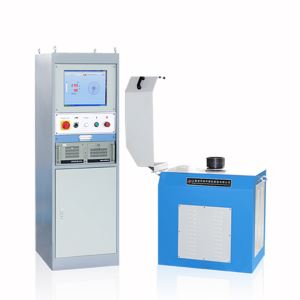
Q.Why is measuring of balancing speed of the component very
important in a balancing machine?
A.Balancing machine is an industrial machine. The machine is
located in a factory environment along the process line. Many types
of industrial noises electrical, mechanical, magnetic will exist in an
industrial environment. Besides this balancing machine has drive
elements like motors, pulleys, belts which also rotate along with the
component. The component is mounted on rollers, and rollers also
rotate along with the component. The transducers will pick up
signals from all rotating elements. The electronics of the balancing
machine needs a reference signal to extract the unbalance signal of
the component being balanced. The speed signal of the component
being balanced provides the reference for signal extraction.
In older stroboscope machines, it can be observed that the
unbalance location will start shifting / oscillating over a wide angle
when balancing is done. In modern machines with phase lock loop,
the shift of angle is reduced to insignificant levels.
Q.Why do we need multi speed balancing machines?
A.Multi speed balancing machines are normally big size machines
and machines which handle a range of jobs. In case the component
is a mass produced component with predictable levels of
unbalance, single speed machines can be tuned to balance the
components faster and well within the tolerance. But in heavy
components, the level of unbalance may not be known initially. It
may be hazardous from the point of safety to directly run the
component at the required balancing speed. So, heavy components
are run at lower speeds, initial balancing is done. Further balancing
is done at higher speeds till the desired level of accuracy is
Achieved.
Q.Do we need to put Dynamic Balancing Machines on a foundation?
A. Balancing machine is an industrial machine used to measure
Vibration and compute the residual unbalance. Modern Hard Bearing
Balancing Machines are force measuring. It is essential that the Machine
do not vibrate or shake for correct measurement of unbalance amount and
phase angle.
For more precise results it is required to mount the machines firmly on an industrial floor.
Q. What is unbalance reduction ratio?
A. Balancing machine instrumentation indicates the level of unbalance on
the component being balanced. A good machine can indicate a value and
when a correction equivalent to the value shown is executed the next resultant residual
unbalance should be below 90-95% of the first indicated value.
For example, on the first run, if the machine has shown say 50 gram at a given location.
When a 50 gram weight is added at that location and a residual unbalance reading taken,
in case the machine indicates a value of 5 gram and below, then it is said that the machine
is having an unbalance reduction ratio of about 90%.
For more details refer to the ISO standards 1940, 2953 etc.
Q. What is plane separation, cross effect, influence?
A. In two plane dynamic balancing machines, the results are indicated in two
correction planes. When a correction is made on one plane, the effect of the
unbalance compensation on the second plane, is defined as plane separation
or cross effect or influence. Normally, the plane separation will be well below 3 %.
In computer based hard bearing dynamic balancing machines, the plane
separation is achieved mathematically. So users tend to get better
levels of plane separation on computerized hard bearing dynamic
balancing machines and that is not the case with soft bearing
machines wherein unbalance signals are electronically mixed and
modulated for indicating the results.